Last Updated: November 14, 2026
Quick Summary
Frame Reality is a Tone Films alternative built on an owner-led, crew-scaled model, so the person accountable for creative direction stays on your project while the crew scales to fit each brief. It combines documentary judgment, event production, and live technical direction, and suits agencies serving government, contractor, healthcare, and mission-led clients.
- Ask vendors to break quotes into production, post, rights and licensing, and contingency and change orders.
- A 60-second master needing 30-, 15-, and 6-second cutdowns in three aspect ratios is 12 deliverables.
- Ask each shop how many revision rounds its base quote includes and how extra rounds are billed.
- Frame Reality is a weaker fit for high-volume, low-complexity social content or a fixed in-house retainer.
- Score vendors on evidence: close-fit projects, a bucketed sample quote, and an agency reference.
Table of Contents
- Why Agencies Compare Tone Films Alternatives in the First Place
- What Agencies Should Weigh in a Video Production Company Portfolio Examples Review
- How Frame Reality Differs From Tone Films: Owner-Led, Crew-Scaled Production
- Video Production Pricing for Agencies: What Actually Drives the Budget
- Government Contractor Video Production: Compliance, Capability Statements, and Procurement
- A Video Production Project Brief Template That Keeps Every Vendor Honest
- Where Frame Reality Fits Your Agency Roster: A Selection Scorecard
- Book a Discovery Call to Scope Your Next Agency Production
- Frequently Asked Questions
Why Agencies Compare Tone Films Alternatives in the First Place
Agencies rarely shop for a new production partner on a whim.
A Tone Films alternative is a production company an agency can plug into its roster for brand films, commercial production, corporate video, event films, or live streams without building a full internal studio.
Most production-company roundups describe vendors as if a marketing director were hiring them directly. Agencies need a partner who can be white-labeled, briefed precisely, and trusted with the client relationship.
What Agencies Should Weigh in a Video Production Company Portfolio Examples Review
Portfolio review is where most agency evaluations quietly go wrong. Reels are edited to look impressive, so the useful question isn't "is this beautiful?" but "does this portfolio prove the shop can do our kind of work?"
When you review video production company portfolio examples, score them against your actual pipeline rather than their highlight reel:
- Range across formats: brand film, commercial production, event film, documentary, and live stream are different crafts.
- Sector fluency: healthcare, nonprofit, government, and corporate work carry different compliance and tone demands.
- Interview and storytelling craft: documentary-style work lives or dies on how subjects are directed.
A common mistake is judging a shop by a single flagship film. Before you shortlist anyone, run through the questions worth asking a video production company so the portfolio conversation stays grounded in how they work.
How Frame Reality Differs From Tone Films: Owner-Led, Crew-Scaled Production
The clearest difference comes down to accountability. Frame Reality is built around an owner-led, crew-scaled model: the person accountable for creative direction stays attached to the project, and the crew grows or shrinks to fit the brief.
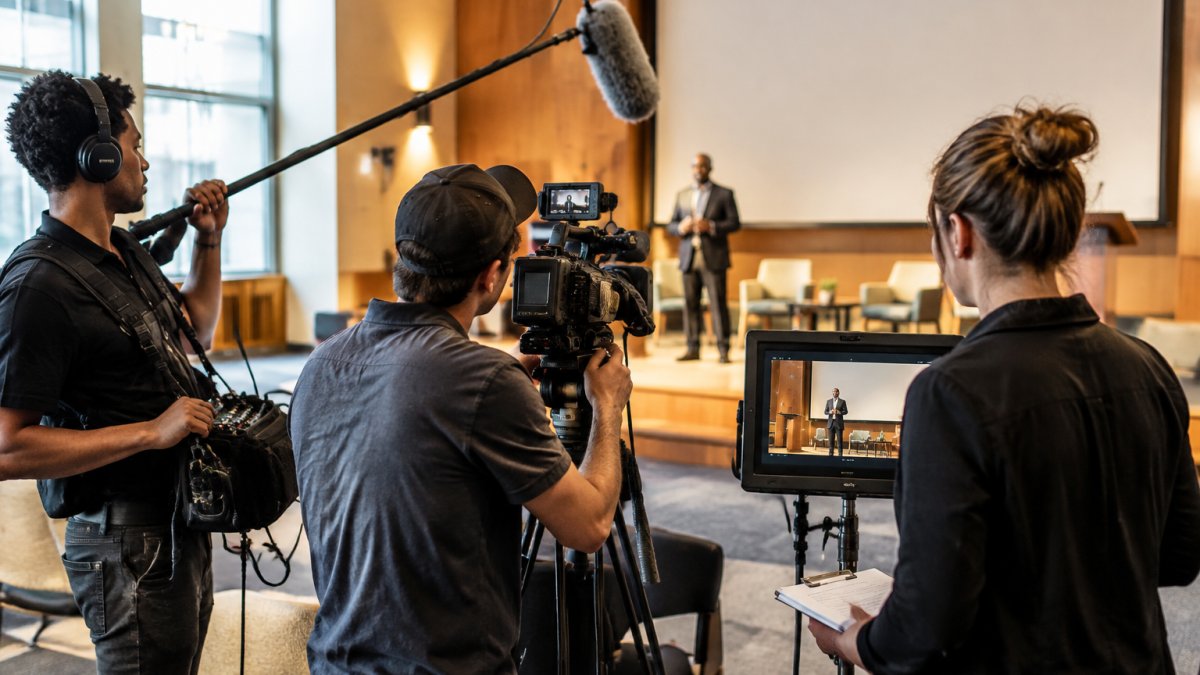
For agencies, that structure changes the working relationship.
Frame Reality suits agencies that need a partner fluent in mission-ready media for government agencies, contractors, and corporate teams. See the full scope on the Frame Reality services page to compare it against your roster gaps.
Video Production Pricing for Agencies: What Actually Drives the Budget
Video production pricing for agencies rarely follows a rate card alone. The same brief quoted by different shops can vary widely, and the spread often comes from what each shop assumes about scope, rights, and revisions.
The main cost drivers are:
- Crew size and roles: director, DP, sound, lighting, and production management each add to the day rate. A two-person interview crew and a five-person multi-camera event crew are different products.
- Shoot days and locations: multi-city or multi-day work multiplies travel, permits, and logistics. Permit costs depend on location and scope.
- Format and complexity: a single interview differs sharply from a multi-camera live stream with technical direction, which adds a switcher operator, a technical director, and redundancy planning.
The four line items agencies should price separately
When you compare a Tone Films alternative against your current vendor, ask each to break the quote into four buckets rather than one lump sum:
- Production, crew, gear, locations, travel, and shoot days.
- Post, edit, color, mix, graphics, captions, and versioning.
- Rights and licensing, talent releases, music licensing, and usage terms by channel and duration.
- Contingency and change orders, the agreed buffer and the rate for work outside the brief.
A quote that hides rights inside production is a quote you cannot defend to a client when the campaign extends to paid social. A quote that names a change-order rate up front is a quote you can actually manage.
What usage rights actually cost
Usage is the single most misunderstood line in agency production budgets. A vendor may price a shoot for a defined window, say 12 months of organic web and social, then charge separately to extend into paid media, broadcast, or a second year. Talent and music licensing follow the same logic. Ask every vendor to state, in writing, the channel, duration, and territory covered by their quote, and the rate to extend each.
Change orders and revision limits
Revision rounds are where agency budgets quietly break. Ask each shop how many revision rounds its base quote includes and how additional rounds are billed. Ask for the number of included rounds, the definition of a round (consolidated notes versus piecemeal feedback), and the rate beyond that. Scope changes after the shoot, adding a deliverable, swapping a music track, re-cutting for a new audience, all trigger change orders, and the vendor's rate card for those items signals how they will behave mid-project.
White-label and agency commission structure
Agencies buy production differently from end clients, and the pricing should reflect it. Ask whether the vendor quotes net of agency commission, whether they will invoice the agency or the end client, and whether they will carry the agency's branding on deliverables and correspondence.
Brief every vendor on the same scope and compare what each includes, not just the headline figure. For a deeper look, the corporate video procurement guide breaks down the purchasing process step by step.
Government Contractor Video Production: Compliance, Capability Statements, and Procurement
Government contractor video production carries requirements most commercial shoots never touch. Capability statement videos, program explainers, and stakeholder communications have to be accurate, reviewable, and defensible, and the vendor has to be comfortable working inside a procurement process.
Three things matter as much as the creative. First, compliance: claims must survive legal and program review, so the production team needs to work from approved language. Second, procurement: your contracts team will ask about vendor qualifications, insurance, and documentation, and a partner who has navigated that before saves weeks. Third, reuse: content built for one proposal or event should extend into milestone coverage and post-event material rather than being archived after a single showing.
A common mistake is treating a capability video as a one-off marketing asset. For the full picture, the practical guide to video production for government contractors covers compliance and procurement in detail.
A Video Production Project Brief Template That Keeps Every Vendor Honest
A written brief is the cheapest risk control an agency has. When every vendor quotes against the same document, differences in price become explainable rather than mysterious.
Project Brief: [Client / Campaign Name]
1. Objective: [What the video must achieve, in one sentence] **2.
The template does one more job: it exposes shops that plan to improvise. A vendor who can map their crew, schedule, and deliverables to each line has done this before.
Where Frame Reality Fits Your Agency Roster: A Selection Scorecard
Choosing between a Tone Films alternative and your current vendor comes down to fit, not a single score. What makes a scorecard useful is weighting the criteria to your agency's actual pipeline and scoring each vendor against evidence rather than impressions.
The criteria that matter to agencies
| Criterion | What to Score | Why It Matters to Agencies |
|---|---|---|
| Engagement model | Owner-led vs. account-managed | Determines who is accountable for creative direction |
| Crew scaling | Fixed team vs. scaled crew | Affects cost fit across small and large briefs |
| Format range | Brand, event, documentary, live stream | Covers more of your pipeline with one partner |
| Sector fluency | Government, contractor, corporate, healthcare | Reduces briefing and compliance friction |
| Pricing transparency | Rate card vs. custom quote | Makes budgets easier to defend to clients |
| Deliverable depth | Cutdowns, captions, versioning | Extends the value of each shoot day |
| Procurement support | Insurance, documentation, compliance | Speeds up contracts and vendor approval |
| White-label readiness | Agency branding, client comms, confidentiality | Protects the client relationship you own |
| Non-solicitation terms | Contract language on direct client contact | Prevents a vendor from becoming a competitor |
| Rights and licensing clarity | Channel, duration, territory stated in writing | Avoids surprise fees when campaigns extend |
How to weight the scorecard
Not every criterion deserves equal weight. Assign a weight from 1 to 5 to each criterion based on how often it appears in your pipeline, then score each vendor from 1 to 5 on evidence. A vendor that scores 5 on format range but 1 on white-label readiness is not a fit for an agency that resells under its own brand, no matter how good the reel looks.
A possible weighting approach:
- Creative fit and sector fluency, highest weight for agencies whose clients have compliance or mission-driven review processes.
- Pricing transparency and rights clarity, high weight for agencies that pass costs through to clients.
- White-label readiness and non-solicitation, high weight for agencies that own the client relationship.
Score against evidence, not impressions
Ask each vendor for the same three pieces of evidence and score what they return:
- Two or three projects closest to your brief, not the flagship reel. Ask what the brief was, what the vendor was responsible for, and what the deliverables were.
- A sample quote with the four pricing buckets broken out, production, post, rights, and contingency, so you can compare line by line.
- A reference from an agency client, not an end client, who can speak to white-labeling, communication, and how the vendor behaved when the scope changed.
A vendor who cannot produce all three is telling you something about how they will behave once the contract is signed.
Where Frame Reality scores well, and where it does not
Frame Reality is built for agencies that need documentary judgment, event production, and live technical direction under one roof, and for owner-led, crew-scaled production. A hybrid event with breakout sessions and a post-event content plan can sit with one partner.
It is a weaker fit if you want a large fixed in-house team on retainer, or if your pipeline is dominated by high-volume, low-complexity social content where a scaled crew adds cost without adding value. Best for: agencies serving government, contractor, healthcare, and mission-led clients. Skip if: you need only a single simple shoot with no post-event or compliance dimension.
The workflow questions the scorecard should trigger
Before you finalize a score, ask each vendor how they handle the agency-specific mechanics that rarely appear in a reel:
- White-labeling: will deliverables, correspondence, and invoices carry the agency's brand, and will the vendor communicate with the end client only through the agency?
- Client ownership: does the contract state that the agency owns the client relationship, and what are the non-solicitation terms?
- Approvals: how many approvers can the vendor accommodate, and how do they handle consolidated feedback versus piecemeal notes?
Score the answers, not the sales pitch. The vendor that answers these in writing before the contract is the vendor that will still be answering them after the first change order.
Book a Discovery Call to Scope Your Next Agency Production
The gap between a good production partner and a frustrating one usually shows up before the first shoot day, in how they handle a brief, a budget question, and a procurement form.
At FR Creative Group / Frame Reality, we build mission-ready media for agencies and the clients they serve.
Ready to scope a project? Start a conversation about your next production and tell us what the brief needs to achieve.
Frequently Asked Questions
What should agencies look for in a Tone Films alternative?
Start with the production model, not the reel. Ask whether the shop is owner-led or account-managed, how it scales crew for multi-city or multi-camera work, and whether it can name the deliverables you will receive (master files, cutdowns, captions, licensed music). Confirm the vendor carries insurance and can handle procurement paperwork. Then review video production company portfolio examples for work that matches your client's sector, not just the most cinematic clips, and request a written scope before any budget conversation.
How does video production pricing for agencies usually break down?
Agency video production pricing typically reflects four drivers: concept and creative direction, pre-production planning and scheduling, shoot days with crew and equipment, and post-production editing and finishing. Multi-camera event coverage, travel, talent, and licensing add cost. Rates vary widely by market and scope, so ask each vendor to itemize by phase and clarify what is included in the day rate. Frame Reality does not publish fixed pricing; request a quote based on your project's dates, deliverables, and crew needs.
Can Frame Reality handle government contractor video production and procurement requirements?
Frame Reality is built for mission-ready media, including capability statement videos and stakeholder communications for government contractors and agencies. The owner-led model means the person who scopes your project stays accountable through delivery, which helps when procurement asks about qualifications, insurance, and compliance. CBE partnership is available. Bring your vendor questionnaire early so the team can address documentation before the schedule tightens.
What is the difference between hiring a video production company and a creative agency for video work?
A creative agency typically owns strategy, messaging, and campaign direction across channels, while a video production company owns the craft of making the film: creative direction on set, crew, equipment, and post-production. Many agencies bring in a production partner for the shoot and finishing while keeping client strategy in-house. That split works well when the production company can collaborate on the client brief and deliver broadcast-quality assets without competing for the client relationship.
How do I compare video production companies fairly?
Use the same brief for every vendor. Score each on portfolio relevance, crew depth for your format, post-production capability, procurement readiness, and clarity of deliverables and rights. Ask who directs, who owns the footage, and what usage rights come with the final files. A vendor-selection scorecard with weighted criteria keeps the decision objective and gives your procurement team a defensible record of why you chose a Tone Films alternative for the project.
