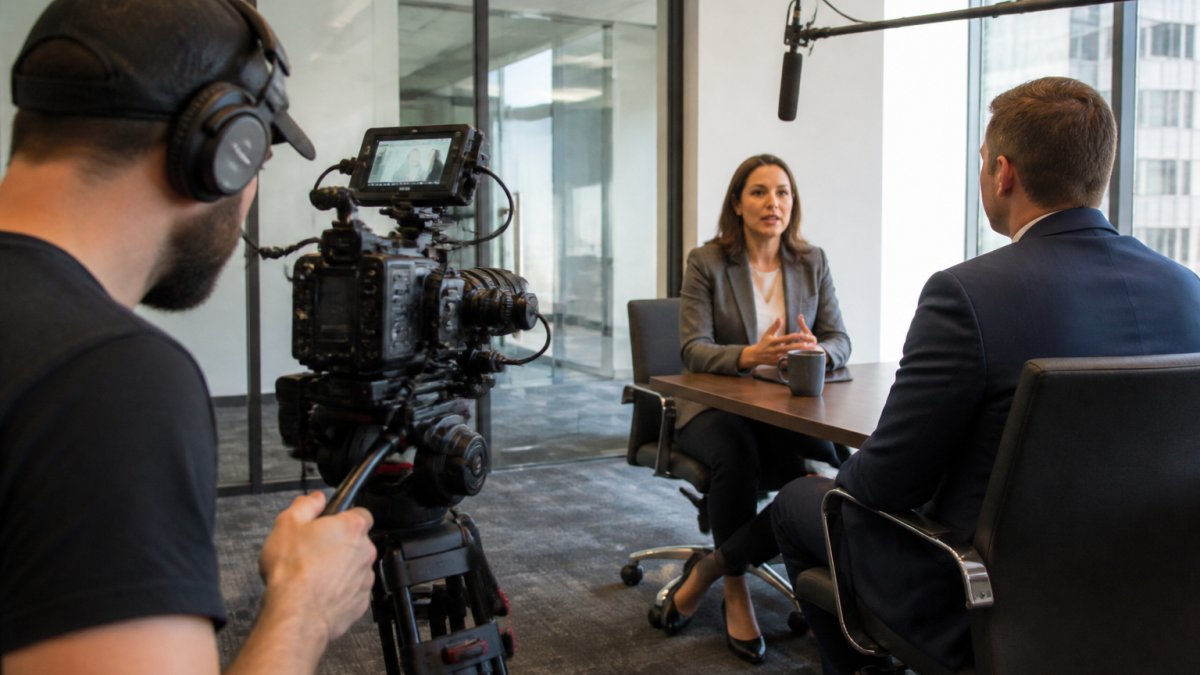
Last Updated: October 27, 2026
Quick Summary
Corporate video production procurement succeeds when you define audience, goals and success metrics before contacting vendors, then score proposals against weighted criteria instead of picking the lowest bid. Publish a six-section RFP with line-item budgets, and lock scope, revision rounds, usage rights and AI disclosure into the contract.
- Shortlist three to five production agencies and score each on the same weighted criteria.
- A 100-point framework weights relevant portfolio at 25 and budget realism at 20.
- Structure the RFP in six sections, including line-item commercial terms and published scoring weights.
- Ask vendors what triggers a change order, how it is priced, and who approves it.
- Require vendors to disclose AI use and warrant rights provenance for all assets.
Table of Contents
- Why Corporate Video Production Procurement Breaks Down in 2026
- Define Project Goals, Audience, and Success Metrics First
- How to Choose a Video Production Company Without Guessing
- Build a Video Production RFP Template That Gets Useful Bids
- Score Proposals With a Vendor Evaluation Framework
- What Drives Corporate Video Production Costs
- A Realistic Corporate Video Production Timeline
- Contract, Compliance, and Risk Controls to Lock In
- Book a Discovery Call Before You Issue the RFP
- Frequently Asked Questions
Why Corporate Video Production Procurement Breaks Down in 2026
Most corporate video production procurement processes fail before a single bid arrives. Teams write a vague request, collect wildly mismatched proposals, and pick the vendor with the lowest number because nothing else is comparable. This guide covers how to run the process, from goal-setting through contract signature.
The stakes are higher than they used to be. Buyers now expect vendor selection to survive an audit, not just a conference room vote. That means documented criteria, scored proposals, and contracts that address usage rights and compliance. Below is a scoring framework and an RFP template you can adapt today.
Define Project Goals, Audience, and Success Metrics First
Every strong corporate video project starts with a written objective, not a creative idea. Before you contact a single production company, define three things: who the video is for, what it must accomplish, and how you will measure whether it worked.
Audience definition drives everything downstream. A conference recap for an association membership calls for different pacing, length, and distribution than an interview series for a federal program office. Write the audience down in one sentence, then write the action you want them to take.
Success metrics deserve the same discipline. A common approach is to tie one primary metric to each deliverable:
- Awareness video: view-through rate and reach within the target audience
- Recruitment or capability video: qualified inquiries or proposal inclusions
- Event video: post-event content reuse count and attendee engagement
- Internal culture video: completion rate and employee survey response
Watch out: skipping this step is the single most expensive mistake in the process. Without defined goals, every vendor proposal becomes incomparable, and the cheapest bid wins by default.
How to Choose a Video Production Company Without Guessing
Choosing a video production company comes down to evidence, not chemistry. A vendor can show you completed work in your sector, explain how they handle approvals and compliance, and describe their crew model in plain terms.
Start with a shortlist of three to five production agencies and evaluate each on the same criteria. Request two or three references from organizations similar to yours in size and sector. Ask specifically how the vendor handled revisions, schedule changes, and stakeholder approvals on those projects.
FR Creative Group, which produces mission-ready media for government agencies, contractors, and corporate teams, uses an owner-led, crew-scaled model.
You can review a vendor's work before you shortlist them.
Questions to Ask Every Vendor
Use this buyer checklist during reference calls and vendor interviews:
- Who is the named producer or director on our project, and will that person stay assigned?
- How do you handle stakeholder approvals and version control on scripts and cuts?
- What is your crew size for a project like ours, and who directs live or multi-camera work?
- How many revision rounds are included, and what does an additional round cost?
- Can you provide a sample scope of work, production schedule, and deliverables list?
- How do you handle usage rights, licensing, and archival of raw footage?
- What insurance coverage and compliance documentation can you supply for procurement review?
Build a Video Production RFP Template That Gets Useful Bids
A video production RFP template works when it forces every vendor to answer the same questions in the same order. Structure it in six sections so proposals arrive comparable rather than creative and chaotic.
- Project background and objectives. State the audience, the desired action, and the primary success metric.
- Scope of work. List deliverables, approximate run times, video formats, and whether event coverage or live direction is included.
- Production requirements. Specify interview subjects, locations, accessibility needs, and any sector-specific compliance rules.
- Schedule. Give your hard dates: approval milestones, shoot windows, and final delivery deadlines.
- Commercial terms. Ask for a line-item budget allocation covering pre-production, production, post-production, and licensing.
- Evaluation criteria. Publish your scoring weights so vendors know how proposals will be judged.
Watch out: an RFP that asks only for a total price guarantees unusable bids. Line-item budgets expose whether a vendor has planned for location scouting, talent casting, and music licensing or simply guessed.
Score Proposals With a Vendor Evaluation Framework
Score every proposal against weighted criteria before anyone sees a demo reel. A simple 100-point framework keeps the decision defensible and comparable across reviewers.
| Criterion | Weight | What to Score |
|---|---|---|
| Relevant portfolio | 25 | Completed work in your sector and format |
| Scope and approach | 20 | Clarity of pre-production, filming, and post-production plan |
| Team and crew model | 15 | Named leads, crew size, live direction capability |
| Budget realism | 20 | Line-item detail and total cost of ownership |
| Compliance and risk | 10 | Insurance, approvals process, usage rights terms |
| Schedule confidence | 10 | Realistic timeline with milestones |
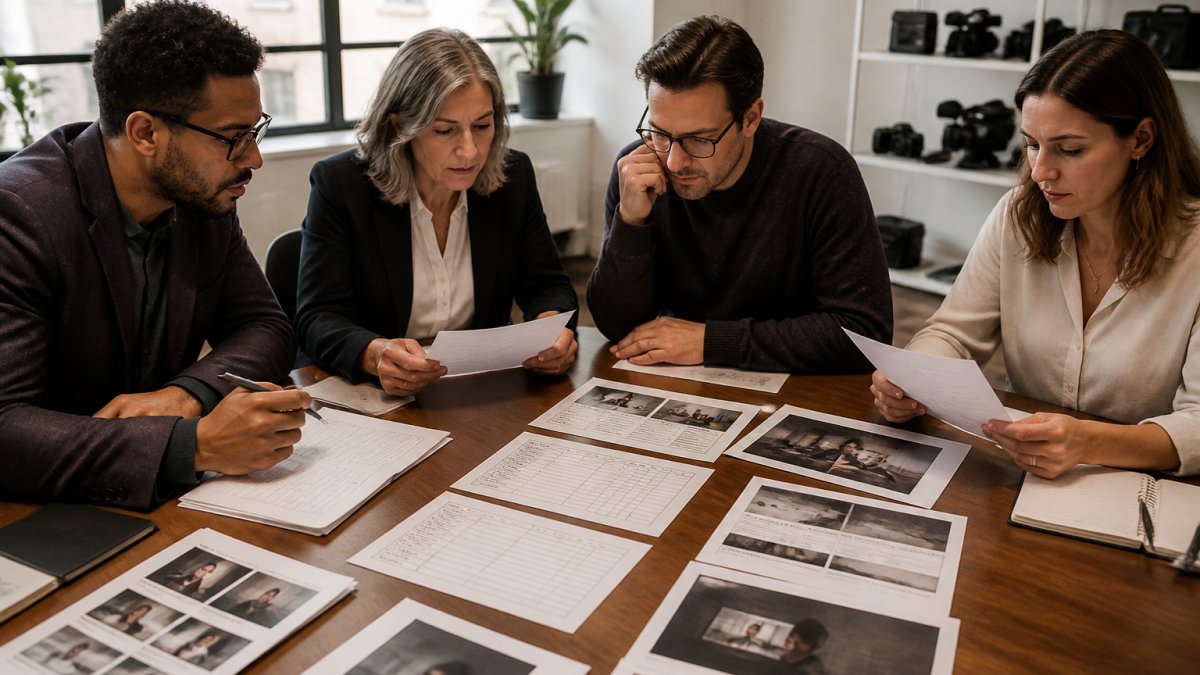
Reviewing real, clearly labeled work samples is one way to judge creative fit during scoring; you can watch approved films to see how a vendor presents finished work.
What Drives Corporate Video Production Costs
Corporate video production costs are driven by scope, not by day rate alone. Two proposals can quote the same total and buy very different amounts of finished, reusable content. The variables that move a budget most are shoot days, crew size, number of locations, interview count, animation or graphics, live direction, and the licensing and usage rights attached to the final deliverables.
Treat any single figure you hear as a starting point for a conversation, not a quote. Ask each vendor to break the budget into pre-production, production, and post-production so you can see where the money actually goes. A line-item budget that shows location scouting, talent casting, and music licensing separately is a planning document; a single lump sum is a guess.
The Cost Drivers, Ranked by Leverage
A small number of variables can account for much of the spread between a lean bid and an ambitious one:
- Shoot days and crew size. Each added shoot day multiplies crew, equipment, and travel. A two-person documentary crew and a ten-person multi-camera unit are different products, not different prices for the same product.
- Locations. Every additional location adds scouting, permits, travel, and setup time. Consolidating locations is the fastest way to cut a budget without cutting quality.
- Interview count and subject scheduling. More subjects means more scheduling risk and more edit material to log and cut.
- Animation, graphics, and motion design. Ask for an estimated hours range.
- Live direction and multi-camera work. Live switching adds technical crew and redundancy that single-camera work does not carry.
- Licensing and usage rights. Music, stock footage, and talent releases priced for one channel cost less than rights cleared for paid media, broadcast, or perpetual reuse.
Compare Commercial Models Directly
Ask each vendor to quote the same scope under the model you intend to use, so the comparison is apples to apples:
- Fixed project fee: predictable and best for tightly scoped single deliverables; change orders are the risk to watch.
- Phased or milestone billing: spreads risk across pre-production, production, and delivery, and lets you stop a project that is going sideways before the largest invoice.
- Day rates plus materials: transparent for documentary and event work where scope is genuinely uncertain, but requires a not-to-exceed cap.
- Retainer or content partnership: suits organizations producing recurring video across a year; confirm what monthly capacity the retainer actually buys.
- Licensing and usage fees: confirm whether footage, music, and talent releases cover future reuse, paid distribution, or localization, and what each extension costs.
A fixed fee is only fixed if the scope is fixed. Ask every vendor what triggers a change order, how change orders are priced, and who approves them.
Total Cost of Ownership and Reuse Math
Total cost of ownership looks past the invoice to what the video returns over its life.
Before you compare totals, ask each vendor to price three things: the base deliverable, a set of derivative cutdowns for social and internal channels, and a defined period of usage rights.
Score proposals on total cost of ownership, not the headline number: base deliverable plus derivatives plus rights plus a realistic change-order allowance.
A Realistic Corporate Video Production Timeline
The schedule below is a working model, adjusted for approvals and shoot availability.
| Phase | Typical Duration | Key Activities |
|---|---|---|
| Discovery and project brief | 1 week | Goals, audience, success metrics |
| Pre-production | 2-3 weeks | Script, storyboard, shot list, location scouting, talent casting |
| Production | 1-3 days | Filming, crew, technical planning, live direction if needed |
| Post-production | 2-4 weeks | Editing, revisions, graphics, sound |
| Delivery and distribution | 1 week | Final formats, publishing plan, archival |
Approval cycles are where timelines slip. Build review windows into the schedule and name a single approver per milestone. If your organization requires legal or communications sign-off, add that time up front rather than absorbing it as a delay.
Contract, Compliance, and Risk Controls to Lock In
Before signing, confirm that the scope of work, deliverables, revision rounds, and usage rights are all written down and match the proposal you scored.
Core Commercial Terms
- Deliverables list: exact formats, run times, and file specifications, including which master files and project files you receive.
- Revision terms: number of included rounds, what counts as a round, and the cost for additional edits.
- Usage rights and licensing: where, how long, and on which channels the footage, music, and talent can be used, plus the cost of extending those rights.
- Approval process: named approvers, version control for scripts and cuts, and a defined response window so silence does not stall the schedule.
- Archival terms: who holds raw footage and final files, in what format, and for how long, and what it costs to retrieve them later.
Insurance, Indemnity, and Compliance Documentation
Ask early about documentation requirements:
- General liability and workers' compensation certificates naming your organization as additional insured where required.
- Equipment and production insurance for shoots on your premises or at events.
- Indemnification and limitation-of-liability language reviewed by your legal team, not accepted from a vendor template.
- Background checks or site-access requirements for crews filming in secure, healthcare, or government facilities.
- Data security and confidentiality terms covering unreleased product, personnel, and customer information captured on set or in raw footage.
Releases, Privacy, and Accessibility
- Talent and location releases for every identifiable person and private property in the final cut, including bystanders at events.
- Music and stock licenses documented in writing, with the license term and permitted uses attached to the contract.
- Accessibility deliverables: captions and subtitles for published video, and audio description where your accessibility policy requires it. Specify these as deliverables, not post-delivery requests.
2026 Technology Terms: AI, Synthetic Media, and Rights Provenance
Procurement teams can address AI-assisted production in the contract. Add terms that require the vendor to:
- Disclose AI use in scripting, voice, imagery, video generation, or editing, and identify which deliverables contain synthetic or AI-generated elements.
- Warrant rights provenance for all footage, music, and images, including that AI-assisted assets were generated with tools whose terms permit commercial use.
- Follow your disclosure policy for synthetic media, including on-screen or metadata labeling where your organization or a distribution platform requires it.
- Protect confidential material from being entered into third-party AI tools without written approval.
- Deliver clean, documented project files so future editors can verify what was generated and what was captured.
Put AI disclosure and rights provenance in the RFP, not just the contract.
For public-sector and contractor work, ask early how the vendor handles compliance documentation. FR Creative Group works with government agencies, contractors, and corporate teams, and can support video production for government, corporate, and mission-led organizations.
Book a Discovery Call Before You Issue the RFP
A discovery call before the RFP can help clarify scope. Discuss your budget, timeline, and compliance needs, then consider whether to revise the RFP before it goes out.
Bring three things to the call: your defined audience and success metric, your hard dates, and your procurement constraints. Ask how the vendor would approach the project and what they would need from you to scope it accurately. Then use what you learn to tighten the RFP.
FR Creative Group combines documentary judgment, event production, and live technical direction to translate complex priorities into clear, credible, and emotionally resonant content. You can contact the team to start a conversation about an event film, documentary, interview, or live production.
Frequently Asked Questions
How do you choose a corporate video production company?
Start with a written project brief, then shortlist three to five vendors whose sample work matches your format and audience. Ask each for a proposal with a scope of work, production schedule, deliverables list, and usage rights. Score them on the same criteria: relevant experience, crew depth, post-production capability, and how clearly they explain cost drivers. Check insurance and references before you negotiate. Consider how clearly each vendor addresses your goals.
What should a corporate video production brief include?
A brief should state the audience, the single message the video must land, distribution channels, target length, and the deadline tied to a real event or launch. Add brand guidelines, approval chain, footage and archive needs, accessibility requirements, and any compliance review the content must pass. Include a rough budget range so vendors can propose a realistic scope of work instead of guessing. The clearer the brief, the more comparable the proposals you receive.
How much does corporate video production cost in 2026?
There is no single figure. Corporate video production costs depend on shoot days, crew size, number of locations, talent casting, animation, and how many revision rounds the contract allows. Multi-camera event coverage, documentary-style storytelling, and heavy post-production each move the number. Ask vendors to break the proposal into pre-production, production, and post-production line items so you can compare bids and see which cost drivers you can remove. Request a quote for your specific scope rather than relying on generic ranges.
How do you compare video production company bids?
Normalize every bid to the same scope before comparing totals. Check whether each includes pre-production planning, location scouting, crew, equipment, editing rounds, music licensing, closed captions, and usage rights. Check whether each bid includes the revisions and deliverable formats you need. Score each proposal against weighted criteria, flag missing line items, and ask vendors to explain gaps. Then compare total cost of ownership, not just the headline number.
What rights and deliverables should a corporate video contract specify?
The contract should list every deliverable format and aspect ratio, the number of revision rounds, and the final approval process. Specify usage rights: where the video can run, for how long, and whether the license covers paid media, internal channels, or perpetual use. Confirm music and footage licensing, ownership of raw files, and archive retention. Add confidentiality, insurance, and termination clauses so procurement has clear risk controls.
How long does corporate video production take?
Build the corporate video production timeline backward from your release date, and reserve buffer for approval cycles inside your organization. Ask vendors for a production schedule with named milestones so delays surface early instead of at delivery.
Running a disciplined procurement process takes more upfront work than calling three vendors and picking a favorite. It also produces something better: a shortlist you can defend, a budget you can explain, and video that keeps working after launch. Get started with FR Creative Group and build a production partnership around story strategy, event coverage, post-production, and delivery planning that holds its value long after release.
