Last Updated: November 12, 2026
Quick Summary
Government safety video production can be worth the investment when it turns dense procedures into short, accurate videos that workers actually watch and revisit. Value depends on keeping content current, meeting Section 508 accessibility rules, and tracking outcomes like incident rates after release.
- Lock every script to a documented, current agency procedure before shooting begins.
- Federal agencies must meet Section 508 accessibility, so plan captions and audio description early.
- Short two- to three-minute clips on single hazards are easier to retain than long modules.
- Require a line-item scope in RFPs so vendor bids can be compared fairly.
- Measure incident rates, near-miss reports and completion times before and after release.
Table of Contents
- Why Government Agencies Rely on Safety Video Production
- Essential Features of Government-Compliant Safety Videos
- Safety Training Video Scripts: From Hazard Analysis to Final Draft
- Workplace Safety Video Examples and Short-Format Formats That Hold Attention
- How to Vet a Production Partner and Measure Return on Your Safety Training
- Frequently Asked Questions
Why Government Agencies Rely on Safety Video Production
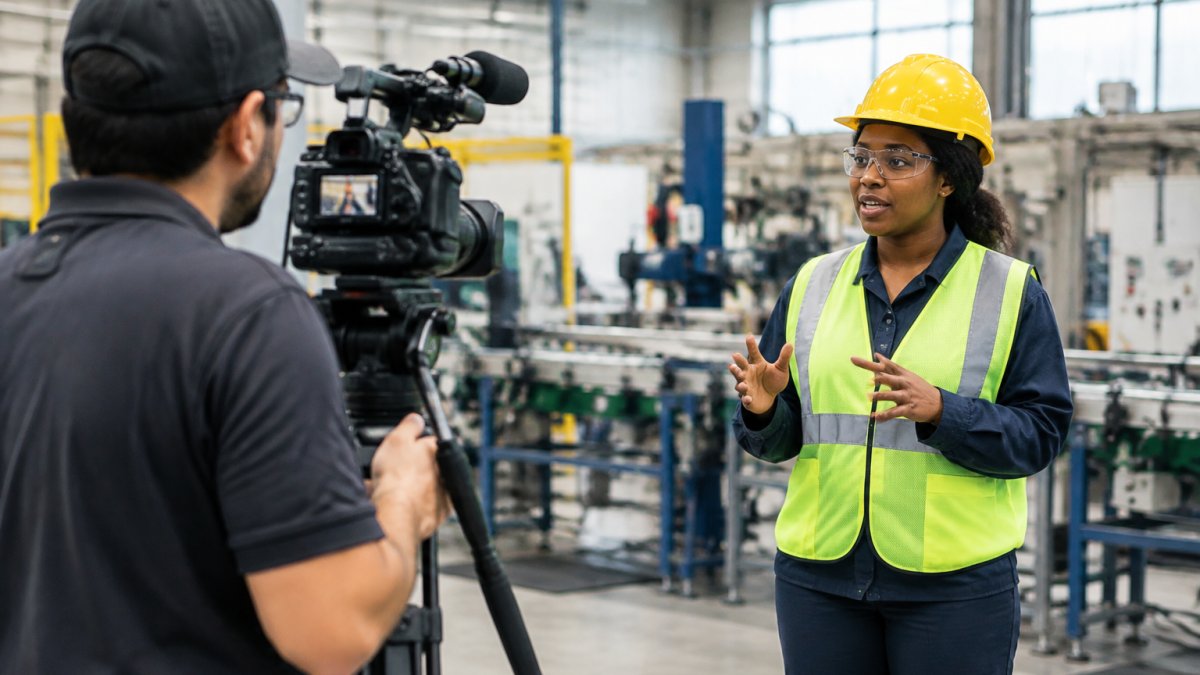
Most safety training fails for a simple reason: workers sit through it and forget it by the next shift. Government safety video production can be a way to change that. A well-made video can hold attention, show real conditions, and give a crew something to refer back to on the job.
Government agencies and their contractors face a specific problem. Requirements are dense, audiences are mixed, and the same message often has to reach field staff, supervisors, and visitors. Video translates procedure into something a person can watch, pause, and revisit. That matters when a single missed step can cost a worker an injury.
Video also gives agencies a durable asset. A training library built once can serve new hires for years, provided the content stays accurate and the production holds up. That is where the investment question starts.
Essential Features of Government-Compliant Safety Videos
Before any filming begins, a government safety video has to meet a clear set of requirements. The content must match the actual procedure, the language must fit the audience, and the file must be usable across the channels the agency relies on. Missing any of these turns a training asset into a liability.
A compliant safety video generally needs:
- Accurate, reviewed procedures that match current agency policy
- Clear on-screen text and captions for every spoken line
- Shots that show the real work environment, not a generic set
- Defined review and approval steps before release
- Versions sized for the platforms where staff will actually watch
A video that looks polished but shows an outdated procedure can do more harm than no video at all, so lock the script to a documented source before shooting.
Accessibility and Section 508 Requirements
Federal agencies must make electronic content accessible under Section 508 of the Rehabilitation Act (IT Accessibility Laws and Policies). Captions, audio description where needed, and players that work with assistive technology are part of that requirement and are worth planning for from the start.
Workplace Hazard Identification and Emergency Response Content
Hazard videos work best when they show the hazard before they name it. Film the real condition, then walk through how to spot it. Emergency response segments need the same realism: clear steps, correct sequence, and a visible reference point a viewer can follow under pressure.
Safety Training Video Scripts: From Hazard Analysis to Final Draft
A strong safety script starts with the hazard analysis, not the camera. List each task, the hazards tied to it, and the controls already in place. Then write the script around those controls in the order a worker would perform them.
Scripts should be short and specific. Name the equipment, state the action, and state the consequence of skipping it. Avoid vague lines like "be careful." Replace them with the exact check a worker must make.
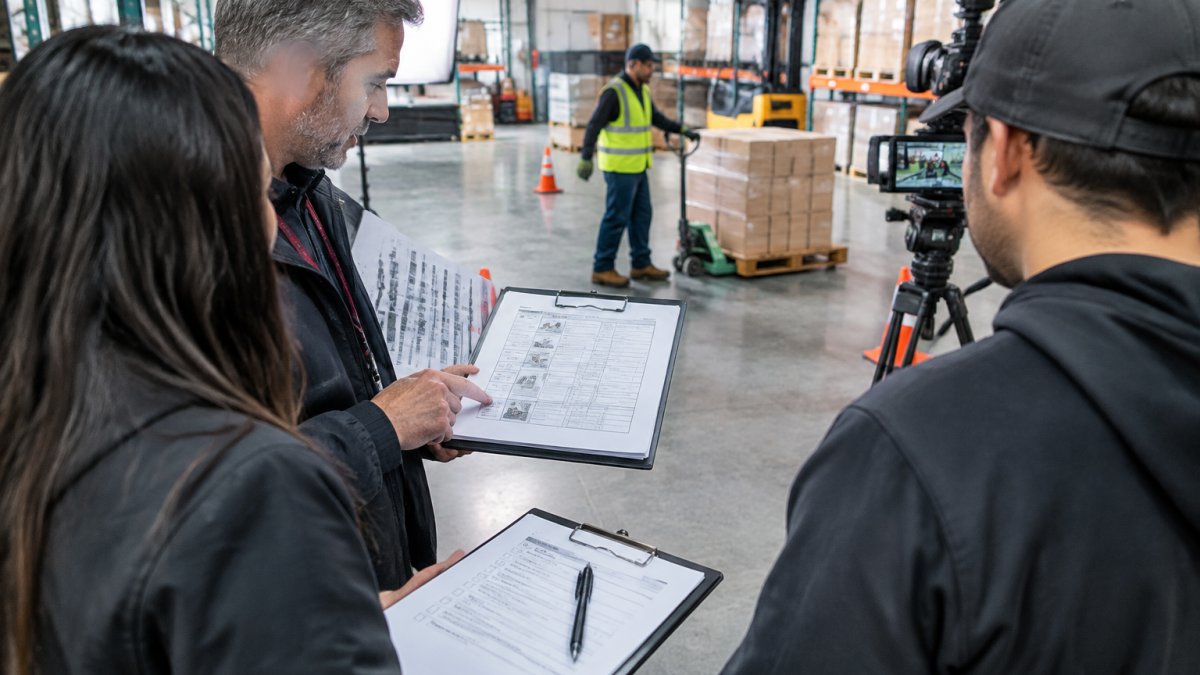
Once the draft exists, run it past the people who own the procedure and the people who will watch it. For a deeper, government-focused guide with scripts and examples, see compliance video production for government agencies. Field staff catch wording that sounds wrong in practice. Safety officers catch gaps in the controls. Two review rounds usually catch most problems before shooting begins.
Workplace Safety Video Examples and Short-Format Formats That Hold Attention
Short formats are often easier to retain than long ones for safety content. A focused two- to three-minute video on one hazard is easier to retain than a thirty-minute module covering everything at once. Break large programs into a series of short clips, each tied to a single task or control.
For government agencies, the format also has to fit how staff are trained and how the content is delivered. Common formats that work well include:
- Scenario clips showing a near miss and the correct response, filmed at the actual site
- Equipment walkthroughs on the real machine, with the control points labeled on screen
- Short refreshers for procedures workers perform only occasionally
- Supervisor briefings that set the context before a task
- Visitor and contractor orientation clips that cover site rules in under five minutes
Documentary-style footage of real workers doing real tasks tends to carry more credibility than actors on a set, and it keeps the content tied to the actual site.
Accessibility is part of the format decision, not an afterthought.
Watch out: a clip that looks polished but shows an outdated procedure can do more harm than no video at all. Lock the script to a documented source before shooting, and date-stamp each clip so refreshers are easy to schedule.
How to Vet a Production Partner and Measure Return on Your Safety Training
Choosing a production partner is the step that decides whether the investment pays off. For public agencies, the process is not a simple vendor comparison.
Start with the procurement path.
A strong RFP response for safety video production should include:
- A written scope that lists scripts, shoot days, crew size, and delivery formats
- Samples of similar regulated-industry or public-sector work
- A clear accessibility plan covering captions, audio description, and Section 508 conformance
- A review and approval schedule that fits the agency's sign-off chain
- A statement of who owns the footage and how revisions are handled after release
- A delivery plan for the formats and platforms staff actually use
Watch out: an RFP that asks only for a price per video will attract quotes that are not comparable. Require a line-item scope so bids can be evaluated on the same basis.
Pricing depends on the number of scripts, shoot days, crew size, and delivery formats, so request a written scope before comparing quotes.
Measuring return is harder than producing the video, and most agencies stop at completion rates. Go further.
For a deeper look at evaluating vendors, see our guide on what to ask a video production company before you hire. If you are weighing a specific project, our government and corporate video production services cover the range of work we take on, and you can start a conversation about your safety video to talk through scope and timing.
The steps below summarise how to vet a production partner and what to measure afterwards.
| Step | What to do | Note |
|---|---|---|
| Confirm procurement path | Check whether the agency uses an RFP, RFQ, cooperative contract or set-aside | Shapes timeline and paperwork |
| Request line-item scope | Ask for scripts, shoot days, crew size and delivery formats | Makes bids comparable |
| Check accessibility plan | Confirm captions, audio description and Section 508 conformance | Required for federal content |
| Set review schedule | Fit the agency's sign-off chain into the timeline | Prevents late-stage delays |
| Track return measures | Compare incident rates, near-miss reports and completion times before and after | Compare against production and incident costs |
Frequently Asked Questions
Are government employees covered by OSHA?
Most federal civilian employees are covered by OSHA through a separate federal sector program, and the Occupational Safety and Health Act of 1970 requires federal agencies to maintain safety and health programs that meet OSHA standards. State and local government employees are generally not covered by federal OSHA, but many states run their own OSHA-approved plans that apply to public employers. Agencies producing safety videos should confirm which rules apply to their workforce before writing scripts, because the required content, training records and reporting obligations can differ between federal and state-plan employers.
How long should a workplace safety training video be?
Short safety videos work best when they cover one hazard, one procedure or one decision at a time, usually in the range of three to seven minutes. Longer programs can be split into a series so each video stays focused and can be replayed at the point of need, such as before a task or at a toolbox talk. Keep the compliance message in the first minute, show the correct procedure on screen, and end with a clear action the worker can take. Track completion and quiz results separately from the video so the training record meets your agency's documentation requirements.
What should a workplace safety video include?
A compliant safety training video should identify the specific hazard, explain how it causes injury, show the controls and personal protective equipment required, and demonstrate the correct procedure step by step. It should also state the emergency response actions workers must take and point to the written policy that governs the task. Include captions and accessible audio description so the content meets Section 508 expectations for federal communications. Scripts should be reviewed by a safety officer before filming so that the technical content is accurate and matches your current written programs.
How do you vet a video production company for a government safety project?
Ask for samples of past work that involved compliance content, not only promotional films, and confirm the company understands accessibility standards such as Section 508. Review how they handle procurement requirements, including insurance certificates, vendor qualifications and documentation for the contracting officer. Ask who will direct the shoot, who will handle post-production, and whether the owner or senior producer will stay involved. Request a written scope that lists deliverables, revision rounds and captioned final files. Pricing depends on quantity, shoot days, locations and delivery formats, so request a written quote for your specific project and contact FR Creative Group / Frame Reality for current pricing or a discovery call.
