
Last Updated: November 4, 2026
Quick Summary
A company culture video works internally when it shows real decisions and behaviors that employees recognize from their own work, rather than polished brand statements. Its main audiences are current staff, managers, new hires and distributed teams. Match the format to a specific internal question, such as values in action, change explanations or onboarding.
- Most culture videos fail internally because they are written as brand statements aimed at outside candidates.
- Keep values videos to 90 seconds to two minutes and show one real decision per value.
- Change explainers should run three to five minutes and cover what, why, who and next steps.
- Caption every video and provide transcripts so employees watching with sound off can follow along.
- Review culture videos every 12 months, and sooner when the policy or process they describe changes.
Table of Contents
- What a Company Culture Video Is and Who It Serves Inside the Organization
- Company Culture Video Examples Worth Borrowing for Internal Audiences
- Values Adoption: The "Value in Action" Series
- Change Management: The "Why This, Why Now" Explainer
- Recognition: The "Behind the Win" Short
- Distributed Teams: The "How We Work Here" Orientation Piece
- Leadership Communication: The "State of the Team" Update
- Onboarding: The "First 30 Days" Orientation Video
- How to Make a Company Culture Video, Step by Step
- Budget, Timeline, and Production Trade-Offs for In-House Versus Outside Crews
- Privacy, Consent, and Fair Employee Representation
- Internal Communication Videos: Distribution, Accessibility, and Reach
- Internal Video Best Practices for Length, Iteration, and Measurement
- Scoping Your First Internal Culture Video With a Production Partner
- Frequently Asked Questions
What a Company Culture Video Is and Who It Serves Inside the Organization
A company culture video is a short film that shows how people actually work, lead and treat one another inside an organization.
Most culture videos fail for the same reason. They are written as brand statements and aimed at outside candidates, so the employees who lived the culture recognize nothing in them.
Internal culture video typically serves four groups:
- New employees, who use it to learn norms that are rarely written down
- Current staff, who need to hear leadership explain direction in a human voice
- Managers, who can point teams to a shared reference instead of repeating the same talk
- Distributed teams, who have fewer chances to absorb culture through hallway conversation
Culture videos also help leadership test its own claims. If a company says it values candor, a video featuring a candid conversation shows whether employees agree. That gap is worth noticing.
Company Culture Video Examples Worth Borrowing for Internal Audiences
Most culture video roundups show the same three formats: a leadership address, an employee testimonial, and a day-in-the-life piece. Those are useful, but they were built for recruiting pages. Internal audiences need concepts that answer internal questions, how a value gets applied, why a change is happening, who is doing good work, and how a distributed team stays connected. The concepts below are organized by the internal job they do, so you can pick the one that matches the message you need to land.
Values Adoption: The "Value in Action" Series
A values video fails internally when it states the value instead of showing it. The stronger format is a short series, one video per value, built around a single real decision an employee made.
Keep each piece to 90 seconds to two minutes, open with the situation, show the choice, and close with the outcome. Run the series over a quarter rather than dumping all the videos at once, so each value gets its own conversation in team meetings. A common pattern is to pair each video with three discussion questions managers can use in a huddle.
Watch out: if every value video features a manager or a top performer, employees read it as a reward program rather than a description of how work actually gets done.
Change Management: The "Why This, Why Now" Explainer
When a company reorganizes, changes a policy, or adopts a new system, the first internal question is not what, it is why.
Use a leader on camera for the decision, then cut to a short segment with someone who will be affected, describing what the change means for their day. That second voice is what separates a change explainer from a memo.
Recognition: The "Behind the Win" Short
Recognition videos work best when they are short, specific, and peer-driven. Instead of a montage of smiling faces, film a two-minute conversation between a manager and a team member about a specific project: what the goal was, what went wrong, and what the person did about it. Post it in the channel the team already uses, tag the people involved, and keep the production simple.
A practical cadence is one recognition short per month, rotating across departments. The point is not production value; it is that the recognition is concrete and comes from someone who saw the work.
Distributed Teams: The "How We Work Here" Orientation Piece
For teams spread across offices, time zones, or remote setups, culture is learned through documents and meetings rather than hallway conversation. A "how we work here" video fills that gap. Cover the practical norms: how decisions get made, how meetings run, how people ask for help, and what the escalation path looks like.
Keep it under six minutes and pair it with a written summary, because remote employees often watch on mobile and will want to skim. Refresh it when a major process changes, not on a fixed calendar.
Leadership Communication: The "State of the Team" Update
A recurring leadership update works internally when it is predictable and short. Aim for a two-to-four-minute video on a regular cadence, with the same structure each time: what we set out to do, what happened, what we learned, and what comes next. Predictability matters more than polish, because employees start to expect the update and plan around it.
Record it in a real workspace rather than a studio, keep the leader looking at the lens, and resist the urge to script every line. A lightly edited take with a clear point lands harder than a flawless teleprompter read.
Onboarding: The "First 30 Days" Orientation Video
Onboarding videos should answer the questions new hires are actually afraid to ask. Cover where to find things, who to ask for what, what the first week looks like, and what success looks like at 30, 60, and 90 days.
A useful pattern is to film the orientation once, then add a short "what I wish I knew" clip from a recent hire each quarter. That keeps the video current without a full reshoot.
Across all six concepts, the same rule applies: pick the format based on the internal question you need answered, not on what looks impressive in a portfolio. A simple recognition short that gets watched in a team channel does more for culture than a cinematic brand film nobody opens.
How to Make a Company Culture Video, Step by Step
The process below moves from strategy to delivery. Each step builds on the last, and skipping the first two usually produces a video that looks good but says little.
- Define the single internal message. Write one sentence describing what employees should understand or do after watching. If you cannot write it, the video is not ready.
- Choose the format. Match leadership messages, employee stories or day-in-the-life pieces to that message.
- Identify your speakers. Pick people who are credible to the audience, not just the most senior or most photogenic.
- Draft a simple outline. Plan three to five beats. Avoid a script that reads word for word on camera.
- Plan the shoot. Confirm locations, release forms and whether you need one camera or a multi-camera setup.
- Shoot with real work in view. Capture the actual environment, tools and interactions.
- Edit toward clarity. Cut anything that does not serve the one message.
- Review with a small group. Share a rough cut with two or three employees outside the project team and ask what they took away.
Watch out: if your reviewers all come from leadership, the feedback will reflect leadership's view of the culture. Include people who work at the front line.
Budget, Timeline, and Production Trade-Offs for In-House Versus Outside Crews
An in-house approach can work well for frequent, lightweight updates such as short check-ins or onboarding clips. It keeps costs predictable and speeds up turnaround.
An outside crew adds specialized skills in lighting, sound, direction and post-production. This matters most for leadership messages, multi-person interviews and any video intended to be reused for years.
A practical middle path is to hire an outside crew for one anchor piece that sets the tone, then produce smaller updates in-house using the same visual style. For help with the story strategy, production, and delivery behind that anchor piece, see story strategy and production services.
The article compares the two production approaches on the factors that shape the decision.
| Approach | Best for | Key trade-off |
|---|---|---|
| In-house crew | Frequent, lightweight updates | Quality can vary; team has other duties |
| Outside crew | Leadership messages and multi-person interviews | Scheduling lead time and larger upfront commitment |
| Hybrid middle path | Anchor piece plus in-house updates | Outside crew sets tone; in-house keeps visual style |
Privacy, Consent, and Fair Employee Representation
Internal video involves people who cannot easily say no to their employer. That power dynamic deserves deliberate handling.
Get written releases from everyone who appears on camera, and explain in plain language where the video will be shown, how long it will stay in use and whether it could be shared outside the company.
Fair representation matters just as much. A culture video that features only one type of employee sends a message about who the culture belongs to. Aim to include people across roles, levels, tenure and backgrounds, and avoid selecting only the most enthusiastic voices.
Internal Communication Videos: Distribution, Accessibility, and Reach
A video only does its job if people actually see it. Internal distribution is often an afterthought, so plan it at the start.
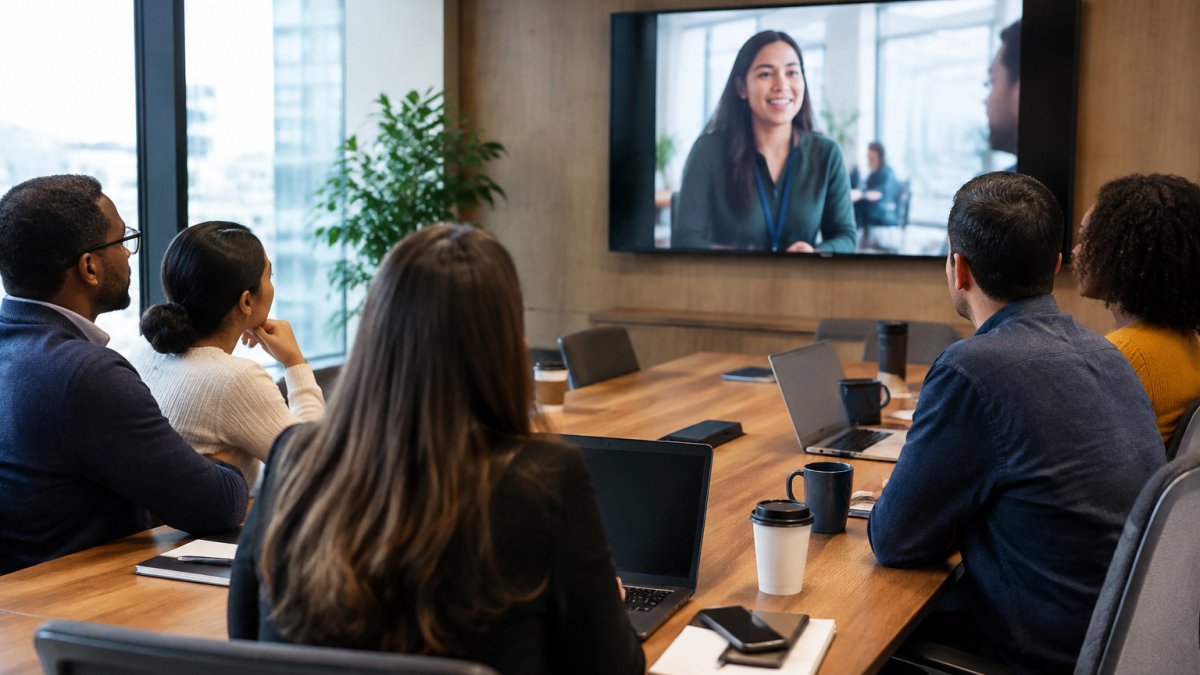
Host the video where employees already go, such as the intranet, the learning management system or a dedicated channel in your team messaging tool.
Accessibility determines who can benefit. Add captions for every video, since many employees watch with sound off in open offices or on mobile devices.
For a global or distributed workforce, plan for time zones and bandwidth.
Good distribution means one video can serve many channels. For guidance on planning rights, captions, and file versions so one production serves many uses, read how to make government videos reusable long after launch.
Internal Video Best Practices for Length, Iteration, and Measurement
Most culture video advice stops at "keep it short and track views." That is not a measurement plan, and it will not tell you whether the video did its job. Internal culture video needs its own outcome framework, because the goals are different from marketing: you are trying to change what employees understand, remember, and do, not drive a click.
Length by Purpose
Length should follow the job the video does. A leadership update works at two to four minutes. A change explainer needs three to five minutes to cover the why. An onboarding orientation can run six to ten minutes if it is chaptered so viewers can jump to what they need. Recognition shorts and team updates work best under 90 seconds. If a video is longer than its purpose requires, the fix is usually to split it, not to speed it up.
Define Outcomes Before You Shoot
Write down what success looks like in measurable terms before production starts. Three outcome types cover most internal culture videos:
- Understanding, employees can correctly explain the message. Measure with a two- or three-question pulse survey sent within a week of viewing, asking employees to state the main point in their own words.
- Participation, employees engage with the video and the follow-up. Measure with view-through rate on the hosting platform, comments or questions in the channel where it was posted, and attendance at any live Q&A tied to the video.
- Recall and reference, the message shows up in later conversations. Measure by asking managers in a monthly check-in whether their team referenced the video, and by searching internal channels for mentions of the video title or topic in the 30 days after release.
Pick one primary outcome per video. Trying to measure all three on every piece produces noise.
A Practical Measurement Stack
You do not need a new analytics platform. Most organizations already have the pieces:
- Hosting analytics, view counts, average watch time, and drop-off point. These tell you whether the video held attention, not whether it worked.
- A short pulse survey, three questions sent to viewers within a week. Keep it under two minutes or response rates collapse.
- Manager check-ins, a monthly question in an existing manager meeting: did your team mention the video, and what did they say?
- Channel search, a monthly search of your team messaging tool and intranet for the video title and topic keywords.
Pair the quantitative signals with a handful of short interviews. Five conversations with employees who watched the video will tell you more about whether the message landed than a dashboard will.
Watch out: view counts are the easiest metric to report and the least useful on their own. A video with high views and no recall is a distribution success and a message failure, and you need to know which one you have.
Iteration: Treat the First Release as a Draft
Plan for a second version before the first one ships. A workable cycle is: release, measure for 30 days, review the data with the project team, and decide whether to revise, reshoot a segment, or retire the video.
Set a review date on the calendar when the video is published. A simple rule is to review any culture video every 12 months, and any video tied to a policy or process whenever that policy or process changes.
Updating Without a Full Reshoot
Full reshoots are expensive and slow. Structure your edits so updates are cheap: film in chapters, keep the intro and outro generic enough to survive a leadership change, and shoot a bank of short clips you can swap in. If a leader leaves or a policy changes, you can replace one chapter instead of the whole piece.
What Not to Claim
Internal culture video is one input among many, and you should be cautious about attributing engagement or retention changes to a single video. Report what you measured, understanding, participation, recall, and describe the limits of the data. That honesty is what makes the next measurement round credible with leadership.
Scoping Your First Internal Culture Video With a Production Partner
If you are preparing your first internal culture video, start with the single message and the audience from the first section of this guide. Then bring a production partner into the conversation early, before the format is locked.
When you talk with a partner, ask how they approach story strategy, how they handle consent and employee participation and how they plan for distribution and reuse. A guide titled 8 Questions to Ask a Video Production Company Before You Hire covers a checklist of questions to ask.
FR Creative Group / Frame Reality works with government agencies, contractors, corporate teams and mission-led organizations, and can talk through whether an internal culture project fits its approach. See video production for government, corporate, and mission-led organizations for the industries and organization types served. For a stronger starting point, you can learn more about FR Creative Group / Frame Reality at madebyfr.com. Start a conversation with FR Creative Group / Frame Reality by reaching out to scope your project, and we will help you decide what to shoot, how to shoot it and how to keep it useful long after launch.
Frequently Asked Questions
What is a company culture video?
A company culture video shows how an organization actually works and what it values, using real employees, real workspaces, and leadership voices rather than scripted slogans. Internal culture videos are aimed at current staff: they reinforce mission, help new hires settle in, and make remote or distributed teams feel connected. The most useful ones show ordinary work in specific detail, because employees recognize authenticity quickly. A good test is whether a current employee would recognize their own workplace in the final cut.
How long should an internal company video be?
Most internal culture videos work best between two and four minutes, long enough to carry a story and short enough to finish during a break or onboarding session. Leadership message videos can run shorter, often ninety seconds to two minutes. Longer pieces, such as documentary-style features, should be split into chapters so employees can return to specific sections. Track completion rates for the first few releases and adjust length based on where viewers stop.
How often should a company share culture videos with employees?
Many teams share one new culture piece per quarter, paired with shorter updates when there is a meaningful milestone such as a product launch, office move, or anniversary. Consistency matters more than volume: a steady cadence builds familiarity, while bursts of content tend to be ignored. Pair each release with a short prompt in a team channel or meeting to start discussion, and retire videos that no longer reflect current leadership or policy.
