Last Updated: October 31, 2026
Quick Summary
A corporate video is a short film a business or agency produces to inform, persuade or build trust with a specific audience. It creates lasting impact when it has one measurable goal, one primary viewer and one clear call to action, set before any script is written.
- Set one measurable goal before writing the script, such as more qualified leads or higher training completion rates.
- Build the message around a single primary viewer and define the one action you want after viewing.
- Assign one named owner per production stage and one approver per review round.
- Lock the script before scheduling the shoot, because script changes after filming add significant cost.
- Map each business goal to a metric, target and data source, and record a baseline before launch.
Table of Contents
- Build a Corporate Video Strategy Around One Audience
- Plan the Production Workflow, Budget and Timeline
- Corporate Video Length and Corporate Video Examples That Hold Attention
- Measuring Corporate Video ROI and Planning Your Next Step
- Frequently Asked Questions
Most corporate videos fail for one simple reason: nobody decided what they were supposed to do.
A corporate video is a short film a business or agency produces to inform, persuade or build trust with a specific audience.
Set one measurable goal before you write a script. Examples include:
- Increase qualified leads from a capability statement by a set number
- Raise completion rates on a training module
- Drive attendance at a regional conference
A goal you can count gives you a way to judge the video later. "Get more awareness" does not.
Watch out: a goal that is vague at the start turns into a debate after the edit is locked.
Build a Corporate Video Strategy Around One Audience
Every corporate video should speak to one main audience. Trying to reach a procurement officer, a board member and a field employee in the same ninety seconds usually reaches none of them well.
Write down who the viewer is, what they already know and what decision they face next. Then build the message around that person.
- Name the single primary viewer
- List the question they need answered
- Note where they will watch (website, conference screen, internal portal)
This keeps the storytelling focused and gives the message a clear shape.
Choosing the Right Format and Story Angle
Format should follow the goal. A capability statement suits a short, direct piece with a clear narrator and proof points. A mission story suits a documentary-style approach that shows people and results. An event recap suits a tighter cut that captures key moments.
Pick the story angle that makes the audience care. Lead with the problem the work solves, not the company's history.
Plan the Production Workflow, Budget and Timeline
Corporate video advice often stops at "have a strategy." The part that actually determines whether a video ships on time and on budget is the production workflow, who does what, in what order, and what each stage costs. This is where projects most often go sideways.
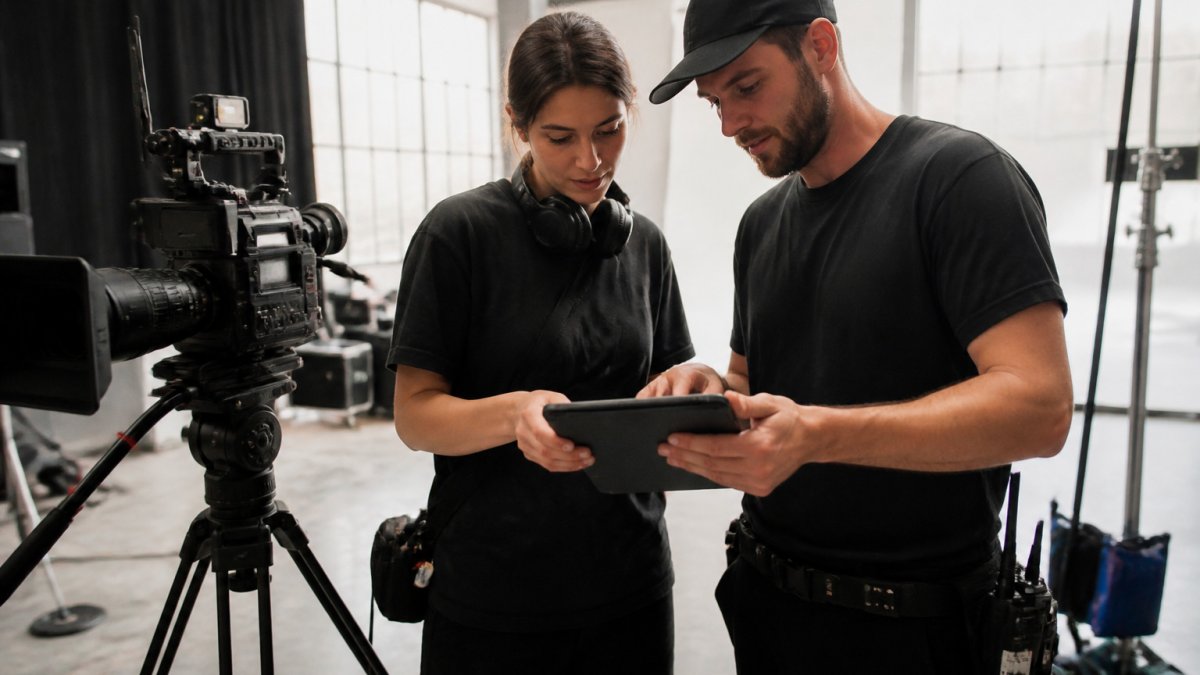
A Seven-Stage Workflow With Clear Owners
A reliable corporate video moves through seven stages. Assign one named owner per stage, and one approver per review round, not a committee.
- Discovery and brief. Owner: account lead. Output: a one-page brief stating the goal, primary audience, single call to action, must-say points, and the date the video must be live. Get this signed before anything else.
- Script and storyboard. Owner: writer or creative director. Output: a locked script plus a shot list or storyboard. This is the cheapest place to make changes, a script revision costs a fraction of a reshoot.
- Pre-production. Owner: producer. Output: schedule, location releases, talent and interview confirmations, equipment list, and a shot-by-shot call sheet. Confirm compliance or legal review requirements here, not later.
- Production (shoot). Owner: director. Output: raw footage, audio, and any b-roll. Build in buffer time; weather, travel, and interviewee availability are the usual culprits when a shoot day slips.
- Post-production. Owner: editor. Output: first cut, then revision rounds.
- Review and approval. Owner: the single designated approver. Consolidate feedback into one document with timecodes. Route legal or compliance review in parallel with creative review so the two do not queue behind each other.
- Delivery and launch. Owner: producer. Output: master file, captions, transcripts, platform-specific versions, and archived project files.
What Actually Drives the Budget
Corporate video pricing depends on scope rather than a single rate card. The main cost drivers are:
- Crew size and specialization, a two-person documentary crew costs far less than a full commercial crew with a director of photography, gaffer, and sound mixer.
- Number of shoot days and locations, each additional location adds travel, permits, and setup time.
- Talent and interviews, on-camera spokespeople, professional voiceover, and union talent each carry their own costs.
Because pricing depends on quantity, dates, and delivery needs, request a written quote rather than relying on general estimates. Ask any vendor four questions before signing: How many revision rounds are included, and what does an extra round cost? Who owns the footage and project files after delivery? What are the usage rights and their term? What is the delivery format and turnaround for final files?
Build the Timeline Backward
Start from the date the video must be live and work backward. Leave that buffer in the schedule rather than discovering it at the end.
- Confirm approvals and sign-off owners first
- Lock the script before scheduling the shoot
- Allow time for at least two review rounds
Corporate Video Length and Corporate Video Examples That Hold Attention
Length should match the job. Longer documentary-style films can run longer when the story justifies it.
Consider examples built around real people and measurable outcomes. Compliance and training videos, for instance, are often scripted to be short, direct and easy to revisit. Review existing corporate video examples in your sector and note what keeps viewers watching to the end.
Testing two cut lengths when the budget allows, then keeping the version with the stronger completion rate, is a practical approach. When you are ready to start, you can call or email FR Creative Group in Washington, DC to begin a conversation about your project.
Measuring Corporate Video ROI and Planning Your Next Step
"Did the video work?" is the question every stakeholder asks and few teams can answer. The fix is to decide what "work" means before launch, then measure against a baseline.
Map Each Goal to a Metric Before Launch
A measurable impact framework connects the business objective to a specific metric, a target, and a data source. Build the table before the script is written, not after the video is live.
| Business goal | Metric to track | Where to find it |
|---|---|---|
| Build awareness | Views, reach, and brand recall in a follow-up survey | Platform analytics; survey tool |
| Drive engagement | Completion rate and average watch time | Hosting platform or social analytics |
| Generate leads | Qualified inquiries or form fills attributed to the video | CRM or marketing automation |
| Support sales | Video-assisted deal progression or proposal-to-close rate | CRM notes and pipeline reports |
| Train or inform | Assessment scores and revisit rate | Learning management system |
| Support events | Registrations or attendance tied to the video | Event registration system |
Set a baseline before launch, last quarter's inquiry volume, the current training completion rate, or the prior event's attendance, so you have something to compare against. A target without a baseline is a guess.
Test and Iterate After Launch
Launch is the midpoint, not the finish line. A practical testing plan looks like this:
- Test the hook. Publish two opening 15 seconds, one leading with the problem, one leading with the outcome, and keep the version with the stronger completion rate.
- Test the call to action. Compare a direct CTA ("Request a quote") against a softer one ("See how it works") and track click-through.
- Test length. When budget allows, cut a 90-second and a 30-second version and compare completion and conversion.
Corporate video ROI is rarely a single figure. It shows up over months in better-qualified conversations with buyers, stronger event turnout, and content that keeps working after release. Document what you learned, which hook, length, and CTA performed best, and feed it into the brief for the next video.
Plan Your Next Step
When you are ready to plan a project, start a conversation with our team at FR Creative Group / Frame Reality about your goal, audience, and timeline. Bring your target metric and baseline if you have them; if not, we will help you define them before production begins. You can also see approved films from our portfolio to judge the storytelling style before you commit.
Frequently Asked Questions
What makes a corporate video effective?
An effective corporate video has one clear goal, one primary audience and one message the viewer can repeat after watching. It opens with a problem or story the audience recognizes, shows real people rather than generic stock footage, and ends with a specific call to action such as a discovery call or a download. Sound quality and clean visuals matter because viewers leave quickly when audio is muddy. Test the cut with a few target viewers before release to confirm the message lands.
How long should a corporate video be?
Length should match the viewer's intent, and recruiting, training or event recap videos can run longer when viewers have a reason to watch. Shorter cuts suit social media and landing pages, and longer documentary-style pieces suit leadership presentations or stakeholder briefings. Match length to the viewer's intent and to where the video will live, and plan a shorter cutdown from the same footage so one shoot serves several uses.
How can you measure the ROI of a corporate video?
Start by linking the video to a measurable goal, such as qualified leads, proposal wins, recruiting applications or internal training completion. Track watch time, completion rate and click-throughs on the call to action, then compare those numbers against the goal before and after release. Reuse the video in proposals, onboarding and events and count those uses, since a video that stays in circulation for months usually returns more value than one shown once at launch.
Creating lasting impact with corporate video takes a clear goal, one audience and a production plan that respects your timeline. Contact FR Creative Group / Frame Reality for a discovery call and we will map the path together.
